
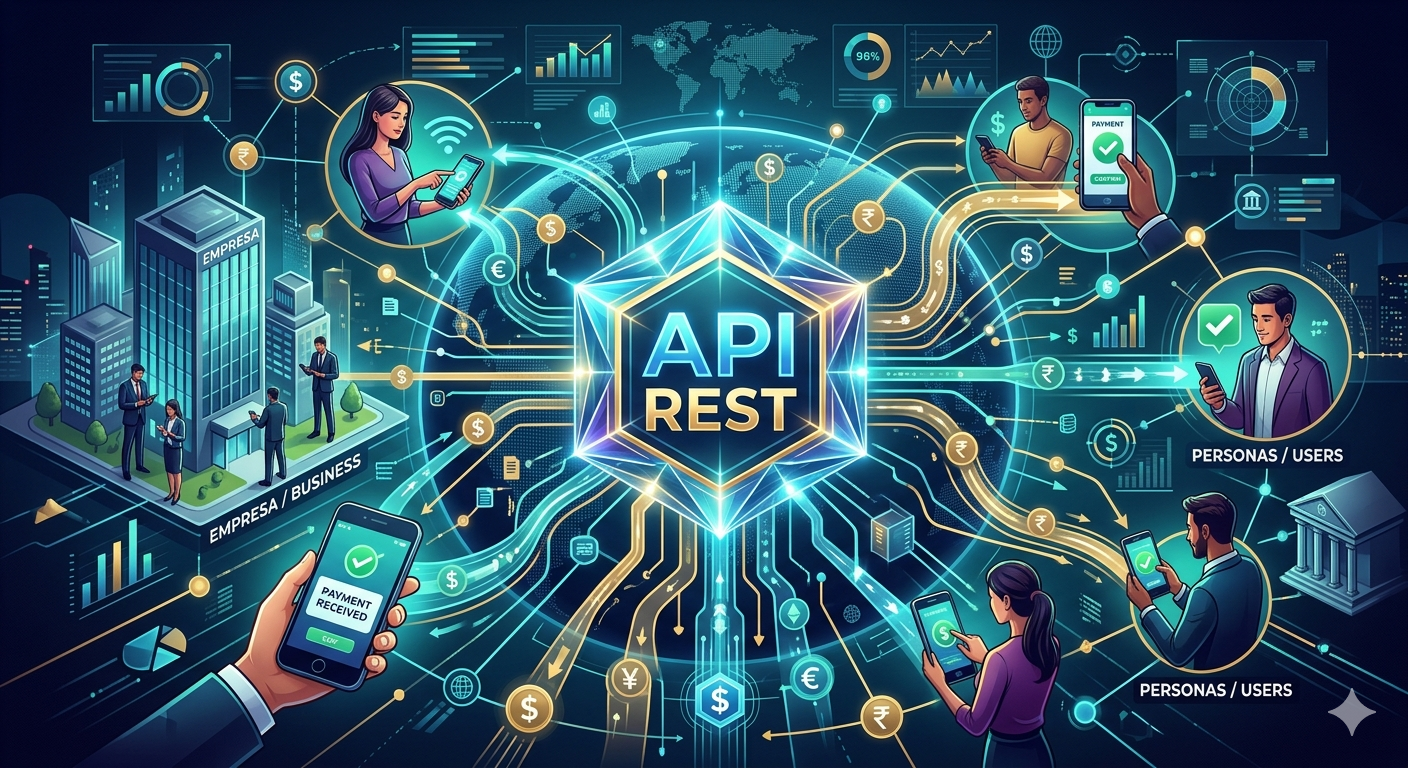
Currently, in an increasingly competitive market, companies’ scalability depends not only on the quality of their products or services but also on the efficiency and robustness of their financial infrastructure, especially when they need to maintain constant liquidity to manage group payments.
Because managing constant transaction flows on a global scale is an operational challenge for many companies, it is important to choose a provider that not only helps reduce operational costs but also provides strategic solutions at the technological and financial levels. Below, we will explore the importance of choosing a group payment provider with an API REST designed for global scale.
Manual processing and the risk of expansion
Managing group payments manually involves slow batch processing, frequent personnel intervention, and significant operational time for the organization. Although these methods may be functional on a very small scale, they represent a growing risk when volume and geographic reach increase. Furthermore, delays and hidden costs can arise when managing large batches of CSV files, manual transfers, or rigid systems, which create high friction and limit the organization’s operational capacity and scalability.
We must highlight that when a company experiences exponential growth, infrastructure limitations can create operational bottlenecks, threatening financial stability and customer service. Therefore, payments must be instant, automatic, secure, and efficient on a global level.
API REST and financial autonomy
An API REST (Representational State Transfer) is a technology that enables companies’ internal systems to communicate with the complex global financial ecosystem in a standardized, automated manner. This “barrier-free” communication capability transforms financial transaction management into a fluid, integrated function, freeing operational personnel to focus on strategic growth rather than payment reconciliation. Because of this, it is important to choose a group payment provider with an API REST focused on operational strategy, as this will guarantee the organization’s global scalability. Below are the main characteristics of an API REST designed for global scale:
Guaranteed horizontal scalability
An API REST designed for global scale not only processes transactions but also is built to handle massive, predictable peaks, such as monthly payday or quarterly settlement day, without service deficiencies.
An efficient API REST guarantees horizontal scalability when a sudden increase in transaction volume occurs at any point in the global market (Asia, America, or Europe), as the architecture can automatically distribute the load among multiple nodes, keeping processing times stable.
Low latency and real-time transactions
When it comes to a competitive global market, latency is synonymous with lost money, since if the API REST has excessive delays when communicating with a bank in another time zone, that delay will directly impact the user experience.
An API REST designed for global scale guarantees a low-latency infrastructure, optimizing endpoints and cross-border connection routes. This ensures that group payments are executed practically in real-time, which is a fundamental factor for companies to maintain operational trust with stakeholders.
Multi-jurisdictional and multi-currency management
Companies that have a presence in global markets and constant growth need to efficiently manage exchange rates, taxes, and banking complexities across multiple jurisdictions. Because of this, the group payment provider must have an API REST possessing high scalability capability, which is designed for complex abstractions of regulatory compliance and currency conversion/settlement, as this allows companies to expand into new countries efficiently, enabling a new connection (or endpoint) without having to redo or restructure the system’s central integration.
Security by Design
The primary objective of bulk payments is to maintain the organization’s financial integrity. Because of this, it is important to choose a payment provider that not only complies with various security protocols and regulations but also has the capacity to incorporate each regulatory requirement into every layer of its API REST.
It is important that the provider includes advanced mechanisms within its API REST for tokenizing sensitive data, cryptographic encryption, and robust fee management protocols, ensuring that even under attacks or extreme traffic peaks, payment information remains secure and unalterable.
What do you think about this topic? Do you wish to learn more about Smart Bulk Payments’ services?
If you are interested in the group payment service with an API REST designed for global scale, you can contact us by visiting the following link.