
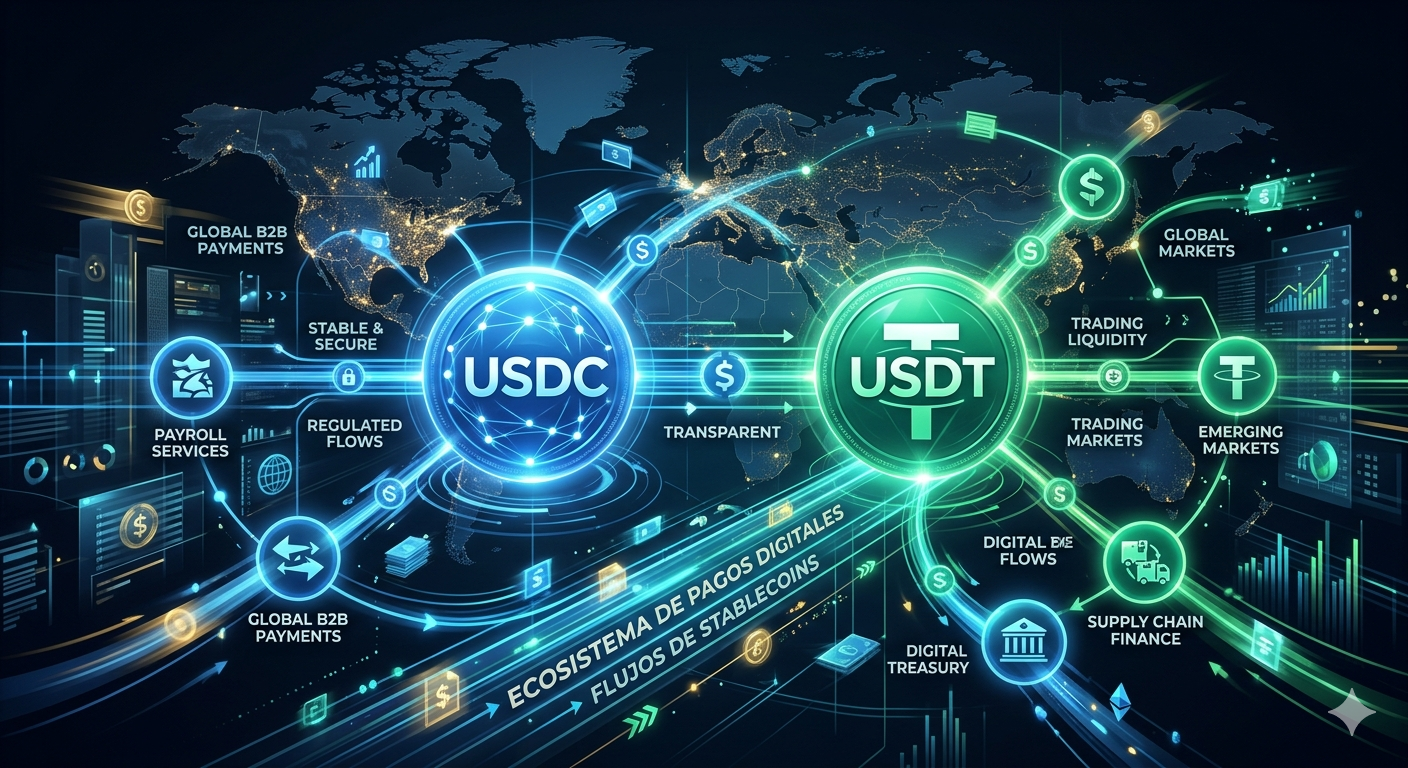
In recent years, companies have increasingly adopted stablecoins like USDC (USD Coin) or USDT (USD Tether) for bulk payments and corporate financial operations, especially for supplier payments, payroll, and international business-to-business (B2B) transfers. However, there are some doubts about the main differences between using USDC and USDT for mass payments. Below, we will explore the main advantages and disadvantages of bulk payments in USDT and USDC.
Market liquidity and slippage
When a company manages high levels of capital through bulk stablecoin payments, market liquidity and slippage (the difference between the expected and actual prices) are essential factors that directly affect the organization’s operational costs and the predictability of its cash flows.
In terms of liquidity, there is a slight advantage to using USDT, as it is a highly popular stablecoin with larger order books and higher trading volumes on global exchanges. This allows for large-scale transfers or conversions with minimal price impact, helping to ensure the 1:1 parity with the US dollar.
On the other hand, there is a greater risk of slippage when using USDC, as it sometimes has lower availability and liquidity on certain global exchanges. This can affect high-volume transactions by moving away from the parity price, reducing margins, and the value received by the beneficiary.
Regulatory compliance and regional legality
When a company manages high levels of capital through bulk stablecoin payments, regulatory compliance and regional legality are indispensable factors that enable smooth operations without hiccups or sanctions.
At this point, we should highlight that large payments in USDC can operate within stricter regulatory frameworks, as USDC is a stablecoin that prioritizes regulatory compliance. This allows companies to have a “clear” legal path across regions and to lower the risk of sudden market exclusion.
On its part, when using bulk payments in USDT, companies use a stablecoin that operates in a less regulated framework but can offer greater flexibility for global operations outside of strictly regulated markets. However, this can considerably limit its utility for companies operating within more regulated markets.
Execution speed
Execution speed is an important factor that allows companies to be more competitive and fulfill their commercial and financial obligations in an increasingly interconnected global market.
Generally, when using USDT for bulk payments, operations are executed thanks to the stablecoin’s high liquidity. On the other hand, when processing large USDC payments, execution may be slightly slower due to its lower market liquidity.
Reserve transparency and audit
Reserve transparency and audit are fundamental factors that not only provide greater confidence but also support effective risk management, regulatory compliance, and operational continuity. At this point, we should highlight that reserve transparency and audit are factors that determine whether a stablecoin can be considered a “reliable” cash equivalent on the company’s balance sheet or, conversely, represents a speculative liability.
By using USDC for bulk payments, companies can adopt a stablecoin that provides independent monthly audit reports, demonstrating that its reserves are entirely backed by cash and US Treasury bonds. On the other hand, when companies use USDT for bulk payments, there is the disadvantage that its audit reports are issued quarterly (instead of monthly) and are not always independent. It is important to note that the USDT stablecoin is not exempt from controversy, as Tether Limited, the company behind it, has faced questions about the transparency of its reserves throughout its history.
Institutional adoption
Institutional adoption is a fundamental factor, as it allows companies to determine the reach, reliability, and technical support they can expect from the stablecoin issuer or the bulk stablecoin payment service provider.
In the case of using bulk payments in USDC, companies adopt a stablecoin that has high institutional trust, is adopted by major financial players due to its strict regulatory standards, and is considered the equivalent of “digital cash” by most corporate institutions. However, USDC has experienced slower adoption in global markets where P2P trade predominates.
On the other hand, for large payments in USDT, companies use a stablecoin that currently dominates P2P platforms and has been well received in emerging markets (where it is considered by many the only option linked to the US dollar). However, most corporate and financial institutions still view USDT as a higher-risk asset, as it can affect institutional integrations.
What do you think about this topic? Do you know of other advantages and disadvantages of bulk payments in USDT and USDC?
If you are interested in the bulk payments in USDT or USDC, you can contact us by visiting the following link.